 Dr. Tasnia Symoom
When Malaysian Prime Minister Anwar Ibrahim shared a video of Prime Minister Tarique Rahman’s official visit accompanied by the Bengali song Amar Bondhu Moha Jadu Jane—“My Friend Knows Great Magic”—the gesture attracted considerable attention in Bangladesh. Though small, it conveyed a degree of cultural recognition and warmth rarely achieved through formal diplomatic statements. Tarique Rahman’s June 22 visit, the first official overseas visit of his premiership, also placed labor mobility, investment, trade, education, and cultural cooperation on the bilateral agenda.
Such symbolic diplomacy can open doors, but lasting influence requires institutional follow-through. This article argues that, for most developing countries not facing an imminent interstate war, a soft-power-led strategy backed by credible but limited defense offers a more realistic path than prestige-driven military competition. Using Bangladesh as a concrete case, it demonstrates how domestic assets, including a young workforce, women’s professional skills, disaster-management experience, green-factory expertise, and civic institutions, can be converted into international partnerships and strategic relevance.
From Attraction to Influence: The Logic of Soft Power
Joseph Nye defines soft power as the ability to shape the preferences of others through attraction and legitimacy rather than coercion or payment. Keohane and Nye’s theory of complex interdependence explains why this capacity has become increasingly important: international relations operate not only through governments and armed forces, but also through trade, universities, workers, businesses, diasporas, professional associations, and digital networks. Niche diplomacy adds a crucial lesson for resource-constrained states: rather than seeking recognition in every arena, they should concentrate on a few areas in which they possess genuine expertise.
The empirical evidence is limited but persuasive. A study of 86 high-level diplomatic visits across 38 countries found that such visits increased approval of the visiting leader by approximately 2.3 percentage points, with effects lasting several weeks. Other research indicates that national reputation can shape trade and investment. Studies of development cooperation likewise show that financial resources alone do not produce goodwill; transparency, local ownership, implementation, and institutional reliability matter. Scholarships and exchanges can create lasting affinity, but their effects are strongest when participants remain connected through professional and alumni networks.
The lesson is simple: visibility creates an opening, but competence and sustained relationships turn that opening into power.
Soft power does not have to be expensive
Soft-power diplomacy is often associated with expensive cultural institutes, international broadcasting, scholarships, or large development projects. But developing countries can also build lasting influence through modest, carefully chosen contributions that respond to a partner’s needs. A frequently recalled example in Bangladesh is President Ziaur Rahman’s initiative to send neem saplings to Saudi Arabia for planting in the Plain of Arafat. Bangladeshi accounts report that the trees later became popularly associated with the name “Zia Tree.” The financial cost was small, but the gesture acquired symbolic longevity because it offered something practical and locally valuable.
The broader lesson is not simply to exchange ceremonial gifts. Developing countries should identify low-cost capabilities that can be shared effectively: volunteer-management systems, professional training, green-factory expertise, early-warning procedures, and short-term technical exchanges. Influence can come from organizing and transferring knowledge well, not only from financing large projects.
Domestic development as foreign policy
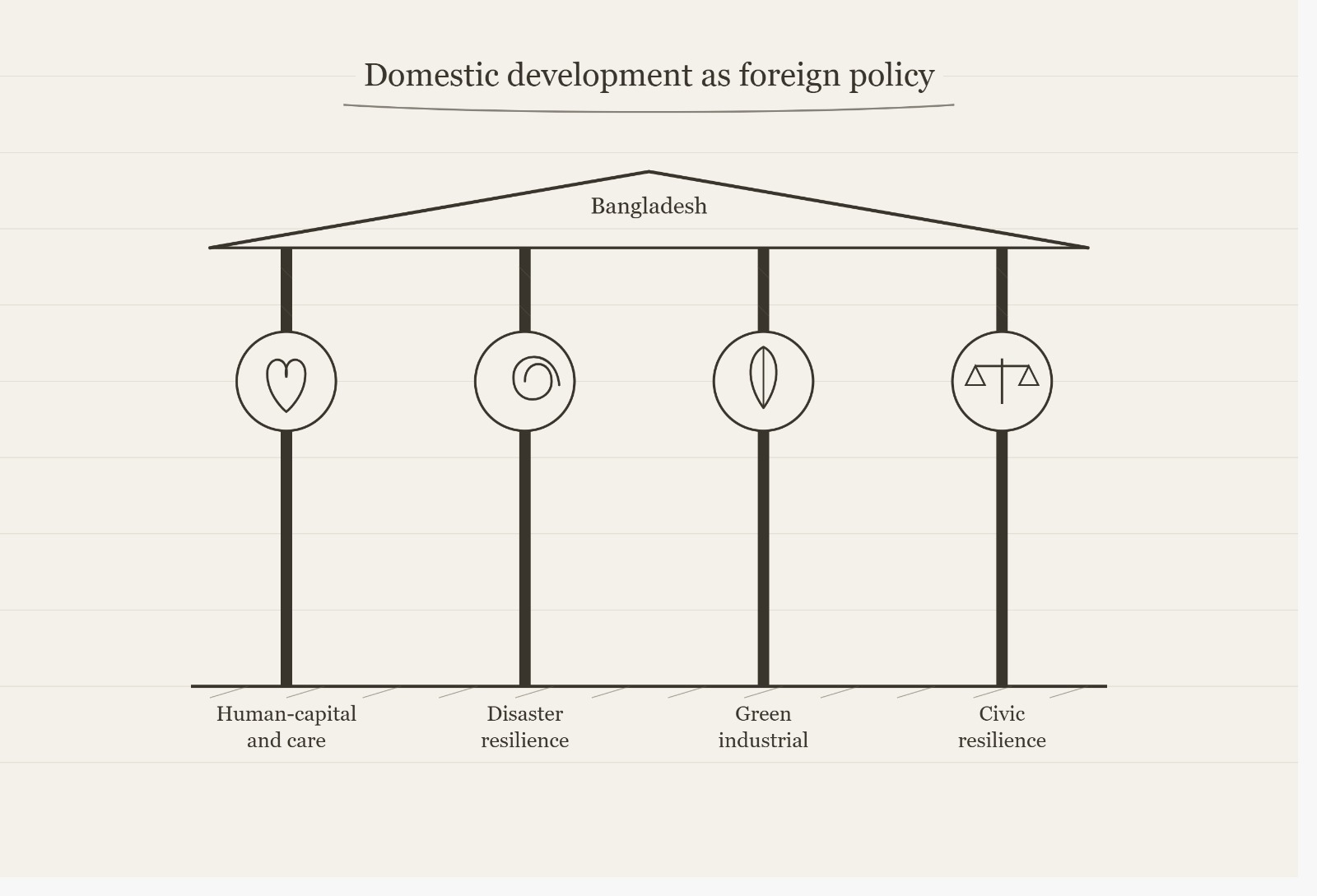
Bangladesh’s most sustainable sources of soft power will not come from publicity campaigns alone, but from domestic capabilities that other countries value. Four areas offer especially credible possibilities: human-capital and care diplomacy, disaster-resilience diplomacy, green-industrial diplomacy, and civic-resilience diplomacy.
Human-capital and care diplomacy: Bangladesh’s young population is often discussed as either a demographic dividend or a looming employment burden. Soft-power strategy requires a third perspective: young Bangladeshis can become a source of international influence when they are trained, certified and protected as skilled professionals.
Bangladesh is underusing a large pool of educated young people and women. According to World Bank data, in 2025, only 37.2 percent of women aged 15 and older were employed. Youth unemployment stood at 8 percent in 2023 and rose to 14 percent among university graduates, while women constituted 73 percent of young people outside employment, education, or training. Bangladesh’s labour-market problems are therefore not merely domestic economic concerns. They affect migration, international reputation, household security and the country’s ability to negotiate with foreign partners.
Bangladesh should develop a strategy of human-capital diplomacy: aligning education, vocational training and professional certification with international labour demand while negotiating fair mobility arrangements with destination countries.
The care economy provides a particularly promising niche. The World Health Organization projects a global shortage of approximately 11 million health workers by 2030. European countries are also facing persistent shortages in health, elder-care and personal-care services as their populations age. The European Commission estimates that millions of openings for healthcare associate professionals and personal-care workers could emerge by 2030.
Bangladesh could train professionals in nursing assistance, elder care, disability support, autism and developmental-disability care, rehabilitation, childcare and community health. This would allow women’s economic empowerment to become part of the country’s international identity.
The garment industry made Bangladeshi women central to the country’s global economic story, but largely through low-paid manufacturing. A professional care economy offers the possibility of a second women-led international sector—this time built around knowledge, certification and socially valuable services.
The Philippines demonstrates how a developing country can acquire a global reputation through nurses, health professionals and caregivers. Bangladesh should learn from that achievement, but also from its risks. Care diplomacy must not become another system for exporting poorly protected women workers. It requires internationally recognized curricula, language training, bilateral recognition of qualifications, employer-paid or tightly regulated recruitment, standard contracts, wage protections, portable benefits and clear career pathways.
Disaster-resilience diplomacy: Bangladesh’s most immediately credible niche may be disaster preparedness and recovery. The country should no longer be known internationally only as a victim of cyclones, floods and climate change. It should also be recognized as a producer of resilience knowledge.
Bangladesh has built a system connecting national forecasting, community early warning, volunteer mobilization, evacuation, first aid and anticipatory action. The Cyclone Preparedness Program now includes more than 76,000 trained volunteers. UNDRR credits the broader community-centered approach with contributing to a dramatic reduction in cyclone deaths over the past five decades.
The armed forces add another dimension. Bangladesh’s Armed Forces Division formally participates in disaster preparedness, training, exercises and emergency response. Bangladeshi military engineers have also repaired roads and infrastructure during UN peacekeeping operations, restoring humanitarian access and economic connections in conflict-affected countries such as South Sudan.
Bangladesh should convert this accumulated experience into resilience diplomacy through a partnership among South and Southeast Asian countries on disaster management. The value of such a partnership would lie in reciprocity. For example, Bangladesh can contribute experience in cyclone preparedness, dense-community evacuation, volunteer warning networks, civil–military coordination and post-crisis engineering. Indonesia brings deep expertise in earthquakes, tsunamis, volcanoes and archipelagic emergency response. Malaysia can contribute urban-flood management, logistics, technology and connections to ASEAN institutions.
Joint exercises, professional exchanges, university research, women-led response training, digital warning systems and deployable regional technical teams would create enduring relationships. They would also train Bangladeshi young people in emergency management, first aid, resilient construction, geographic information systems, communications and logistics—skills valuable both at home and abroad.
Green-industrial diplomacy: Bangladesh has another underused source of international influence: its experience in operating green garment factories at scale. As of July 2026, Bangladesh had 290 LEED-certified green factories, the highest number in the world. Earlier in the year, 69 of the world’s 100 highest-rated green factories were reportedly located in Bangladesh. This achievement is especially significant because it emerged within a manufacturing sector frequently criticized for environmental damage and poor working conditions.
Bangladesh should convert this factory-level experience into green-industrial diplomacy. Factory managers, engineers, regulators, university researchers, and worker-safety specialists could offer short training programs on energy and water efficiency, waste reduction, safer workplaces, environmental certification, traceability, and the management of large-scale industrial upgrading. These programs would cost far less than overseas infrastructure projects while creating professional relationships and demonstrating Bangladesh’s practical competence.
African countries seeking to expand apparel manufacturing provide a natural arena for this cooperation. Ethiopia is developing textiles and garments as a priority export industry and, in 2026, launched an initiative to improve climate resilience, workplace safety, resource efficiency, and circular production across 40 factories. Bangladesh could contribute factory-management experience through joint training, technical exchanges, and partnerships among industrial associations and universities.
Brazil should be approached as a co-learning partner, not as a recipient of Bangladeshi knowledge. Brazil’s national circular-economy strategy emphasizes reuse, recycling, waste recovery, innovation, and skills development. Bangladesh brings extensive experience in green factory construction and export-oriented apparel management, while Brazil can contribute expertise in circular-economy regulation, materials recovery, recycling systems, and sustainable design. A Bangladesh–Brazil textile partnership could connect factory efficiency with circular production.
Bangladesh should not overstate its achievement. Its strongest present claim is leadership in green factory management and certification, while textile recycling and circularity remain underdeveloped. Acknowledging these limitations would make cooperation more credible.
Civic-resilience diplomacy rooted in shared histories: Bangladesh’s commitment to equality and civic rights is rooted in its own national history. The Language Movement of 1952 defended linguistic dignity against state-imposed hierarchy; the 1969 Mass Uprising demanded democratic representation; and the 1971 Liberation War emerged from resistance to political, economic, and cultural discrimination. The Proclamation of Independence placed equality, human dignity, and social justice at the foundation of the new state. This history gives Bangladesh a credible basis for promoting civic awareness, equal citizenship, and unity through diversity as part of its diplomacy.
These experiences also create natural common ground with African societies shaped by anti-colonial, anti-apartheid, and anti-discrimination struggles. The African Charter on Human and Peoples’ Rights affirms equality before the law and rights without distinction based on race, sex, language, religion, or political opinion. South Africa’s post-apartheid Constitution similarly places human dignity, equality, human rights, non-racialism, and non-sexism among its founding values. Sierra Leone’s civic-education initiatives also connect young people’s understanding of rights, responsibilities, history, and cultural diversity with peaceful and inclusive citizenship. Southeast Asian countries add further experience in managing religious and cultural pluralism.
Bangladesh could use this shared historical foundation to make civic resilience a distinct area of diplomatic engagement. It could initiate an International Center for Civic Resilience, Equality, and Pluralism, linking universities, teacher-training institutions, research centers, and civic organizations across South Asia, Southeast Asia, and Africa. Bangladesh’s diplomatic role would be to convene partners, facilitate institutional agreements, support exchanges, and create a sustained platform for joint learning rather than export a single national model.
Through these partnerships, Bangladesh could strengthen civic awareness at home while building durable relationships with countries that share similar histories of resistance and demands for equal rights. Civic-resilience diplomacy would therefore allow Bangladesh to contribute a distinctive voice to international discussions on democracy, human dignity, pluralism, and social inclusion.
A selective strategy toward the Global North
Developing countries should not carry the same message to every advanced economy. Their strategy should identify where domestic capabilities overlap with the immediate priorities and vulnerabilities of each partner. For Bangladesh, the two clearest openings are AI workforce development with the United States and disaster-resilience cooperation with Australia.
With the United States, Bangladesh should focus on AI education and workforce development. Rather than approaching the United States only as a source of technology, Building on its proposed human-capital strategy, Bangladesh could pursue US partnerships in affordable AI applications, Bengali-language tools, teacher training, vocational AI literacy, and responsible adoption in education and industry. Such cooperation would connect American technological interests with Bangladesh’s domestic need to create skilled employment.
Australia offers a different opening. It continues to confront bushfires, floods, cyclones, severe storms, and risks to remote communities. Bangladesh and Australia could therefore develop a reciprocal resilience partnership drawing on their complementary experience. Bangladesh could contribute its community-centered warning, evacuation, and volunteer-management systems, while Australia could contribute expertise in bushfire response, remote-area logistics, satellite technology, and emergency communications. Joint research and practical exchanges would allow both countries to learn from distinct forms of vulnerability.
Credibility is the foundation
Soft power cannot compensate indefinitely for poor governance, corruption, unsafe workplaces, migrant exploitation, weakened civic space, or failure to implement agreements. A care-diplomacy strategy will collapse if women workers face abusive recruitment. Green-manufacturing diplomacy will fail if labor and environmental laws remain unenforced. A civic-resilience center will become propaganda if participating governments suppress pluralism at home.
Domestic performance is therefore part of foreign policy. The treatment of workers, women, minorities, students, and citizens is among the most visible messages a country sends abroad. For Bangladesh—and for much of the Global South—power through partnership is not an idealistic alternative to statecraft. It is one of the most realistic forms of statecraft available.