 Dr. Nazmus Sakib
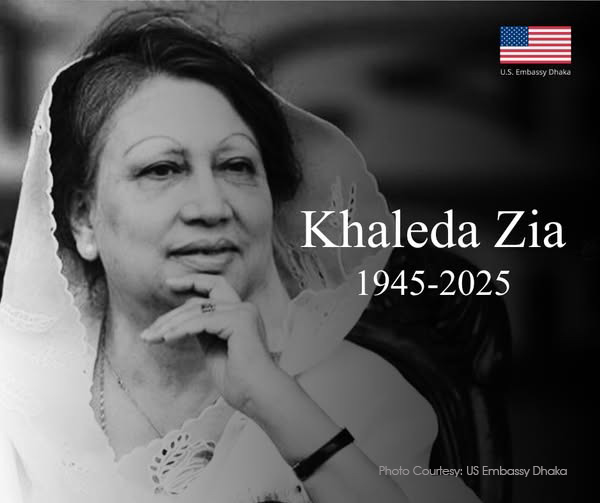
Bangladesh is mourning the loss of Begum Khaleda Zia, its first female prime minister – and the United States has lost a true friend. Khaleda Zia, who passed away at age 80, was a trailblazer for women in South Asian politics. Rising to power through Bangladesh’s first post-military rule elections in 1991, she shattered glass ceilings to become her country’s first woman premier and only the second woman ever elected to lead a Muslim-majority nation (after Pakistan’s Benazir Bhutto). Her historic victory marked a triumph for democratic aspirations in a region long dominated by male leaders and authoritarian regimes. Khaleda Zia’s legacy is inseparable from the story of Bangladesh’s struggle for democracy: she helped topple a military dictator in 1990, then governed the new democracy twice (1991–1996 and 2001–2006), fiercely opposing any return to autocracy. As Americans reflect on her passing, Mrs. Zia’s legacy should be remembered as a rare and true friend of the American people when forging such friendship was costly.
Khaleda Zia – along with her late husband, President Ziaur Rahman – was instrumental in building and expanding U.S.–Bangladesh relations during and immediately after the Cold War era. In the late 1970s, after Bangladesh’s liberation war, President Ziaur Rahman boldly reoriented the young nation’s foreign policy toward the West. He reversed socialist, isolationist policies and embraced free markets and multiparty politics, moves that dramatically improved ties with Washington. This was a courageous stance in Cold War South Asia, with India tilted toward Moscow, and many regional leaders flirted with socialism. Yet Ziaur Rahman and later Khaleda Zia charted a different course – one of friendship with the United States – even when it meant diverging from regional currents . They saw in America a partner for Bangladesh’s development and security, and they were unafraid to align openly with Washington’s camp at a time when such alignment was rare and politically delicate. U.S. officials took note: a 1980 White House memo described Zia as “openly avowed” in his friendship toward the U.S. and “seen in Bangladesh as being pro-American”, praising his efforts to establish orderly government and resist Soviet influence in the region .
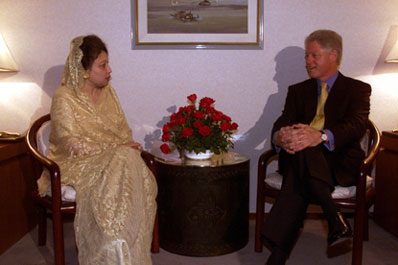
Photo Courtesy: David Scull
Khaleda Zia particularly carried forward her husband’s pro-U.S. orientation with determination. Politically, they kept Bangladesh in the fold of the free world, championing multi-party democracy and moderate governance – attributes Washington applauded . Militarily, Bangladesh under their leadership contributed to U.S.-backed international efforts, from peacekeeping missions to the Gulf War coalition. Economically, Khaleda Zia pursued the Washington Consensus based open-market policies that welcomed foreign investment and trade, integrating Bangladesh’s economy with the global system in ways that benefited from U.S. support. Khaleda’s governments maintained the confidence of the business community with pro-investment policies and liberalization measures, which dovetailed with U.S. interests in a stable, prosperous Bangladesh.
Importantly, Khaleda Zia’s pro-American alignment was not without risk or controversy. In a region where anti-U.S. sentiment and suspicion of Western motives often ran high, her stance required political courage. She believed that Bangladesh’s sovereignty and success would be reinforced by strong ties with the United States—a belief buttressed by the tangible gains in aid, trade, and military cooperation during her years in power.
When Khaleda Zia visited the White House in 1992, she and President Bush reiterated their condemnation of the military junta of Burma who was causing a refugee influx in Bangladesh at that time. Surprisingly, Bangladesh is still suffering from the same issue that had lingered and exacerbated since then. Thanks to the Chinese backing, the junta in Burma is the reason that Bangladesh is hosting more than 1 million Rohingya refugees who fled for their lives from Arakan. This is one of the avenues in which the US and Bangladesh can gain from a cooperative effort. A few months after Bangladesh supported the US military operation to liberate Kuwait, the country was struck by a devastating cyclone. In response, the United States launched Operation Sea Angel, one of its largest-ever military relief missions, deploying 7,000 troops for two months to deliver lifesaving aid by helicopter to remote villages across Bangladesh. Under Khaleda Zia’s leadership, Bangladeshis saw the United States as a true friend in need for the first time.
The 1990s saw Bangladesh’s ready-made garments emerge as a major export to the U.S. market. Khaleda personally lobbied Washington for increased quotas – raising the issue with President Bush in 1992 and emphasizing that garment exports were crucial for employing women and developing Bangladesh’s economy . By the mid-1990s, the United States had become Bangladesh’s largest export market, adding a strong commercial pillar to the relationship, while U.S. investment in energy and power during Khaleda Zia’s first term signaled growing confidence beyond traditional aid ties. All of these efforts earned her high praise from the U.S. State Department, which described U.S.–Bangladesh relations as “unquestionably excellent” by 1996, when Khaleda left office . In her second term, when faced with domestic terror attacks by a militant group, Bangladesh launched a robust counterterrorism drive, outlawing militant groups and arresting hundreds of suspects. Right after the operations, President Bush praised these efforts: he “lauded [Bangladesh’s] drive against corruption and terrorism” . In her second term, Bangladesh participated in U.S.-led regional exercises. Under Khaleda Zia, Bangladesh deepened quiet security cooperation with the United States through humanitarian exercises, maritime patrols in the Bay of Bengal, and expanded UN peacekeeping deployments, with U.S. support in training and logistics, strengthening military ties without a formal alliance. Even after the worldwide textile quota system under the MFA ended in January 2005, Bangladeshi garment shipments to the United States under Mrs. Zia continued to surge in the post-quota environment, growing by roughly 20–25 percent annually around 2005. The U.S. remained Bangladesh’s #1 export destination, with apparel making up over three-quarters of exports. Khaleda’s government also continued liberalizing the economy by IMF and World Bank programs. U.S. officials complimented some of these reforms – for example, privatization efforts and anti-corruption initiatives.
This is not, however, to undermine the fact that bilateral relations between Mrs. Zia’s government and the United States were not without hiccups and divergences. While security cooperation deepened in areas like counterterrorism training and UN peacekeeping support post-9/11, the U.S. expressed recurring concerns over the rise of Islamist militancy during her 2001–2006 term—particularly following deadly attacks by groups like Jamaat-ul-Mujahideen Bangladesh (JMB) in 2005—and perceived inadequacies in addressing it decisively. Additionally, despite U.S. praise for certain economic reforms and privatization efforts, American officials and international observers highlighted persistent systemic corruption. These issues occasionally strained ties, even as trade and military engagement grew.
As Khaleda Zia is put to rest and Bangladesh is preparing for a first democratic election after an authoritarian hiatus, surprisingly, it has been over 25 years since any Bangladeshi prime minister last set foot in the White House. In this context, Washington might consider acknowledging aspects of her contributions—particularly in fostering certain areas of economic reform and security engagement—through restoring leader-level diplomacy, beginning with an invitation for the next prime minister, whoever they might be, to visit the White House, marking the first in over a quarter-century.
Strengthening bilateral relations would signal renewed recognition of Bangladesh as a valued partner and open the door to deeper cooperation on Bay of Bengal military and logistical access, expanded trade and defense procurement, counterterrorism and intelligence sharing, coordinated pressure on Myanmar over the Rohingya crisis and critical minerals, and closer alignment with the U.S. Indo-Pacific strategy, while firmly supporting Bangladesh’s democratic transition as essential to regional stability and shared prosperity.